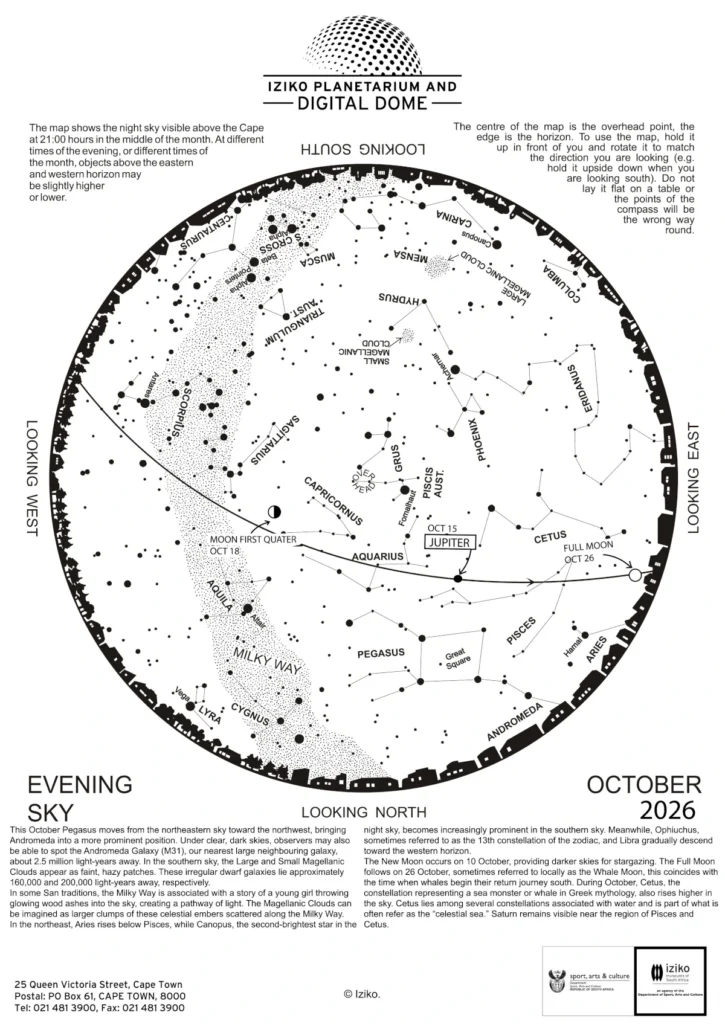
October skymap 2026:
This October Pegasus moves from the northeastern sky toward the northwest, bringing Andromeda into a more prominent position. Under clear, dark skies, observers may also be able to spot the Andromeda Galaxy (M31), our nearest large neighbouring galaxy, about 2.5 million light-years away. In the southern sky, the Large and Small Magellanic Clouds appear as faint, hazy patches. These irregular dwarf galaxies lie approximately 160,000 and 200,000 light-years away, respectively.
In some San traditions, the Milky Way is associated with a story of a young girl throwing glowing wood ashes into the sky, creating a pathway of light. The Magellanic Clouds can be imagined as larger clumps of these celestial embers scattered along the Milky Way.
In the northeast, Aries rises below Pisces, while Canopus, the second-brightest star in the night sky, becomes increasingly prominent in the southern sky. Meanwhile, Ophiuchus, sometimes referred to as the 13th constellation of the zodiac, and Libra gradually descend toward the western horizon.
The New Moon occurs on 10 October, providing darker skies for stargazing. The Full Moon follows on 26 October, sometimes referred to locally as the Whale Moon, this coincides with the time when whales begin their return journey south. During October, Cetus, the constellation representing a sea monster or whale in Greek mythology, also rises higher in the sky. Cetus lies among several constellations associated with water and is part of what is often refer as the “celestial sea.” Saturn remains visible near the region of Pisces and Cetus.
Download the October Sky Map HERE.