By Eunice Malatji, Assistant Curator: Iziko Social History
Technology has drastically transformed the way in which people meet their basic needs. It has made production and manufacturing of goods and services less time consuming and easily accessible. There were times when production took time and days, producing a product that only takes minutes in these days of technology. However, the methods used in the ancient days informed the technology that we have today. A bellow that was once used as an important tool for traditional iron smelting in Africa, long before the arrival of the Europeans, now sits at a museum as reference to the changing times of technology.
There are gradual changes that took place from ancient times to our recent times which introduced technology. Stone was the primary accessible material for making tools. The development into iron smelting led to the creation of tools to facilitate the iron smelting process. A bellow is a special tool in the process of iron smelting designed to blow air into the furnace. While the furnace required fire to keep the heat to a maximum to excrete the molten liquid iron, the bellow played an important role in ensuring combustion.
Iziko Museums of South Africa, in its Social History Collections, hold in its collected works, different types of bellows produced in Africa. The 1700s was the time when there was a need for designing tools for agricultural purposes, following a transition from the middle stone age to the new stone age. The use of metal tools for daily subsistence, which placed the smelting of iron on high demand, generated this transition. Subsequently, this led to the invention of furnaces and bellows, with different designs emerging with high-quality improvements over the years in different areas of Africa.
There are two bellows, amongst all the collections of bellows, designed differently but both consists of animal skin. The commonly used skin was a goat skin, and in most cases, the goat was skinned alive for ritual purposes guided by a belief that it enables smoother production process. The preservation of the goat skin was ensured through rubbing the skin with cattle dung and leaves which contain tannin, a natural pest control plants. In southern Africa, grass was used to fill the bellow bags to allow for compression and transmission of air into the furnace.

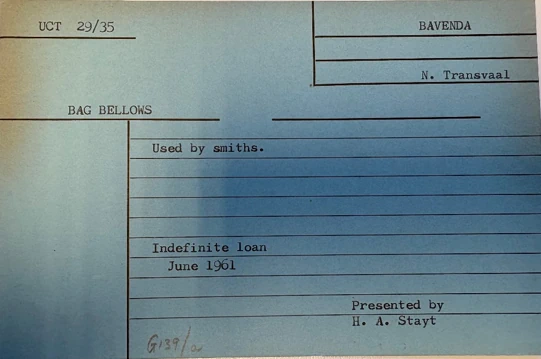
The skin bag bellow collected from Venda has been preserved in the museum’s care since June 1969. It is made of a goat skin and a nozzle. The nozzle, which connects to the tuyere on the furnace is made of wood. Bellow nozzles are different, depending on the times in which they were designed and the region. In the beginning of time when bellows were designed, an antelope horn was used, which is why a bellow nozzle can also be referred to as a discharge horn.

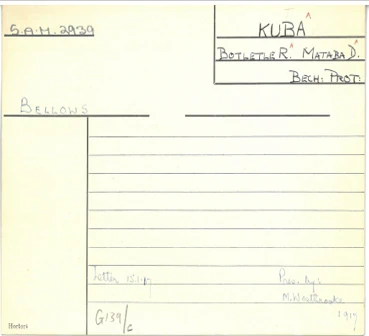
The drum bellow was collected from Botswana, Botletle river known as Boteti, and was presented to the museum in 1917. The drum bellow design allowed for a large air quantity flow. It is made of two merged wooden drums which are crafted through the nozzles. The drums are covered with goat skin tied with a craftly twisted rod made of reed. There are sticks attached to the skin on the drums to allow for pumping air through constantly pulling, allowing air to fill the drum and releasing to allow air to flow through the nozzles into the furnace. This process continued until the final product was excreted. Iron ore was added into the furnace throughout the process for larger quantity production. The commonly used tree in Botswana for making the drum bellows is called (Mukwa), Pterocarpus angolensis.
Although technology erased the indigenous ways of smelting iron in Africa through its introduction of machinery, improving quantity production and convenience, the role played by the bellows and the load of work required in ensuring that these bellows were productive cannot be forgotten. The bellows provides evidence of perseverance and patience while also requiring human strength. It required continual pumping of air with men taking turns in compressing the skin bag bellow or pulling the drum bellow sticks. The pulling and compression required change in shifts to allow for rest. These artifacts demonstrate a traditional tactical skill of the craftsmen of the time.
The indigenous iron smelting process has a social footprint. From acquiring the materials of making a bellow or the furnace, duties had to be shared amongst the men working in the iron smelting. This serves as an introduction to social organisation and division of labour. Gender roles can also be seen in this type of labour as only men were responsible for the iron smelting process and designing the tools to facilitate it. The changing of turns amongst men in compressing the bellow introduced the system of shift work, where there must be a person responsible to continue blowing air into the furnace.
Bellows represents a shift in technology from the 1700 to recent time. The preservation of these bellows is a representation of indigenous intelligence and creativity in the absence of modern machinery. In the indigenous process of designing iron tools, bellows required more attention due to the important role they played in keeping the coals alive. A goat skin had to be present for the bellow to be produced. In regions where an antelope horn was used as a nozzle, a Sable antelope had to be hunted to get the horn. The horn had to be refined, and a hole carefully pierced to allow air to pass through. Using wood also required a sculpting skill to refine the wood into a required shape and to pierce a passage for the flow of air.
The museum plays an important role in ensuring that these iconic artefacts are well preserved. The artifacts form part of the museum collections safely stored in the museum’s cupboards. The bellows provides knowledge on ancient special skills and intelligence. With iron still produced with the use of machinery, bellows are of monumental importance in reflecting through the times when daily subsistence was achieved through hard labour without machinery.